
DIY produce stand

It all started with potatoes — and having no place to put them.
We usually ended up sticking them in the cereal cabinet and the bag would fall behind the boxes and we’d end up with musty spuds growing sprouts. Ew.
So when I saw a great-looking produce stand online (OverTheBigMoon.com), I knew it was something we needed for the kitchen. A place for potatoes! Could it really be so simple? Maybe we could get the bananas off the counter, too.
Are you lacking cupboard space and need a new home for fruits and veggies?
Here’s what you need to make your very own produce stand:
- Two (2) 1 x 6 boards (10 ft. long) for the boxes
- One (1) 1 x 4 board (8 ft. long) for the sides
- Two (2) 10” pieces of a 2 x 4 for the base supports
The first step is to make your cuts …
- Cut your 1×6 boards into nine 18” pieces (the back, front and base of your boxes) and six 7” pieces (the ends of your boxes).
- Cut two 32” sections from your 1×4 board (you’ll have some wood leftover) to form the sides. Then cut the tops at angle (about 30 degrees) so your boxes will tilt slightly to display their contents.
- Take your two 10” pieces of 2×4 and cut a 45-degree angle off each end to make pretty base supports.

Once you’ve made your cuts, it’s time to assemble it!
Start by building your three boxes. Remember, each box has an 18” inch piece as the back, front and bottom — and the little 7” pieces made the ends. We pre-drilled the holes so the wood didn’t split, and then hammered in 2” nails.

When you have three perfect wooden boxes, you’ll probably get really excited about future projects that could involve boxes. I mean, storage is always important, right? And they’re so sturdy!
Once I calmed down about the boxes, it was time to attach the sides to the base supports. Make sure you screw or nail the sides to the bases so that the angles are facing the right direction, because the very top box needs to line up with that angle.

When you have your “legs,” grab one of the boxes and hold it, slightly tilted, so it matches up with the top of the angled side. Your box will be pitching forward slightly. Pre-drill your holes and screw or nail it in place, and then repeat on the other side. It will look like you have a strange sort of mailbox with two legs.

Align your final two boxes by comparing the angle to the first box — eyeballing it is fine — and then secure them to the sides. You can hang them at any height, really, but we aimed to space ours equally.

Take a minute to admire your stand, and then decide on a plan of action. Are you going to seal it and leave the wood natural? Stain it? Paint it?
I was tempted to stain ours, but we already have a lot of wood happening on that level. So I painted it with leftover greyish-blue wall paint (CIL’s “Bear Run”) that we used on most of our main level, since I knew I wanted to put the produce stand against a greige wall.

The morning after that single coat of blue, I roughed up the edges of the stand with a bit of sandpaper, wiped off the dust, and moved it into place. I loved it instantly. It kind of felt like a mini grocery store.

Our potatoes aren’t going to turn into science experiments in the cereal cupboard, and the bananas are no longer shoved between the coffee machine and the KitchenAid. Who knows, the kids might eat more apples now that they’re pre-washed and displayed at their level?

I wonder what else can go in there. Hmmm, I think I need to Google “What produce doesn’t need to be in the refrigerator?”

10 tips for hanging a gallery wall

I have an obsession with gallery walls. I don’t know what it is about them — the textures, the shapes, the chaos? — but I just adore them.
We already had nine (I think? I might be losing count), but when I decided to redo my home office recently, I knew I wanted to create another.
TIP #1: Gallery walls don’t have to be expensive.
I started by rounding up some frames. You can re-use old frames, buy second-hand frames, or buy cheap frames from a dollar store. In this case I only had two real frames to re-use — my frame stash is getting low! — so I painted them both white.
TIP #2: Keep it cohesive.
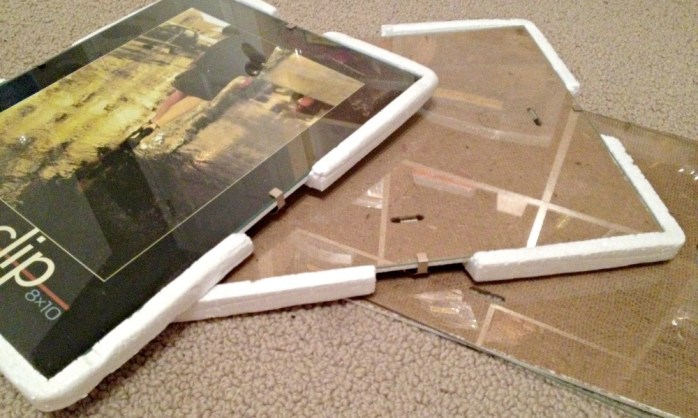
I like to paint all of the frames one colour — or just a few different colours. I also used a few dollar store “document holders” (glass and cardboard with metal clips), which didn’t require painting because they’re frame-less.
TIP #3: Make your own mats.
I knew I wanted really bold mats — since so many of the frames were really document holders — so I bought two black and white chevron duotangs in the school supplies section of a big-box store ($0.97 each) and cut them down to fit the frames. Then I taped a photo on top of each one, and clipped on the glass.

TIP #4: Frame cards!
I used a few family photos, and also two greeting cards I’d received that I found really funny. There are so many awesome cards out there that make wonderful (cheap) artwork.
Some gallery walls are just framed photos, but I like to include letters and shapes, too.
TIP #5: Add wooden letters and shape for texture.
Since this gallery wall was going in my home office/craft room, I went a bit wild and bought wooden letters to spell out my initials, as well as “Write,” “Create,” and “Sew.” I buy my letters when the craft store runs a “20 per cent off your entire order” sale, because letters can average around $4.99 each. It adds up quickly!
I also bought some wooden hearts, a little key, and a cute arrow that says “me” — so I could point it at my initials. Then I coated everything with white paint — leftover trim paint in off-the-shelf glossy white — and let it dry.

TIP #6: Lay everything out on the floor.
I always lay out my gallery walls on the floor so I find an arrangement I like. An easy way to start is by picking one item to be the focal point — in this case it was my “HLC” letters, but often I choose my nicest (largest) frame. Once you have a focal point, choose your largest items and find good spots for them around it. Then you can use the smaller items — frames, wooden shapes, letters — to fill in the spaces.

TIP #7: Take a picture!
Once I’m happy with the arrangement, I take a picture of it for reference when I’m hanging everything. You might think you’ll remember. You won’t.
TIP #8: Start in the centre.
I hang the focal point first — right in the centre of the wall — and then slowly hang one item at a time, making sure I’m keeping the arrangement the same as what’s on the floor.

TIP #9: Space everything evenly.
I cringe when I see a gallery wall with random spacing between each item. It should be as consistent as possible — 1-2 inches between everything is my go-to, and I just eyeball it.
TIP #10: Get sticky (strips).
Sticky velcro picture-hanging strips are great for hanging gallery walls, because you can adjust things slightly if needed — and it’s the only way to hang up tiny wooden letters. Just be careful when you take them off because … yeah, I have ruined some walls in my day.

I’m so happy with my newest gallery wall, especially how the crisp white letters stand out on my newly-painted red walls. It’s inevitable that someday I’ll have a gallery wall that’s nothing but wooden letters.
I’m pretty sure I’m all out of blank walls in my house, so can I come to yours and make a gallery wall now? Please?

Make a giant paper mâché letter

Here’s something you should know about me: my projects don’t always turn out like I’d planned — sometimes they totally bomb — but I’m just stubborn enough to keep working on them until they turn into something decent.
This, my friends, was one of those projects.
It all started when I saw these awesome oversized paper mâché letters on Pinterest. It seemed so simple, and it would be totally free to make! I could have a huge white “C” for my dining room.
Lord knows I spend enough money buying ceramic and wooden letter Cs from the craft store, right? My little sister often jokes, “You know what this wall needs? ANOTHER LETTER C.”
Well, it turns out that I might be better off buying them. Paper mâché is a fickle, fickle foe.
Here’s how it all went down …
I started by cutting two large Cs out of bristol board. You need to be sure they’re exactly the same size, because they’ll be serving as a top and bottom of your finished letter.
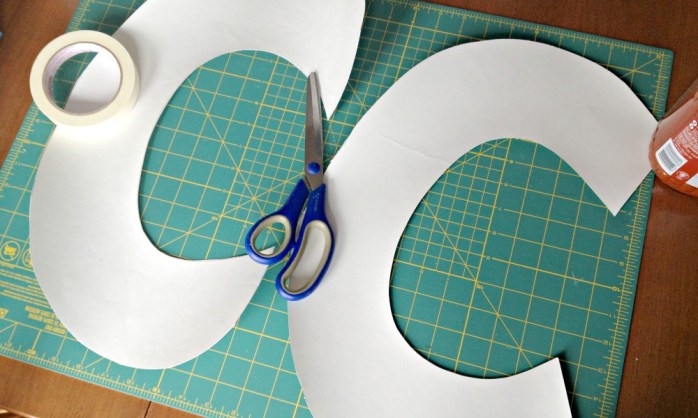
I grabbed a package of mini paper cups, and used my trusty hot glue gun to attach them to one of the letters. The paper cups act as the ‘filling’ to give your letter depth, and keep it nice and strong.
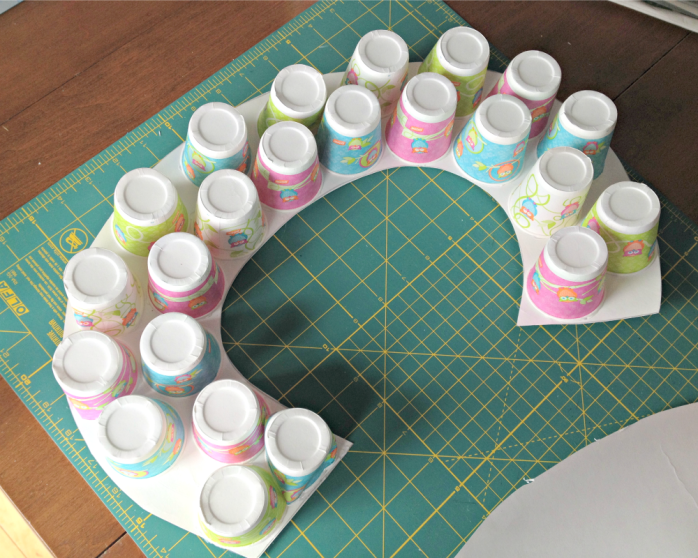
Then I put the second C on top, and wrapped masking tape around the entire thing. The tutorial on Pinterest called for paper tape, but I didn’t have it — and I have a personal (stubborn) rule about not running to the store once I’m into a project. I just make do! (Spoiler alert: this was totally a mistake.)
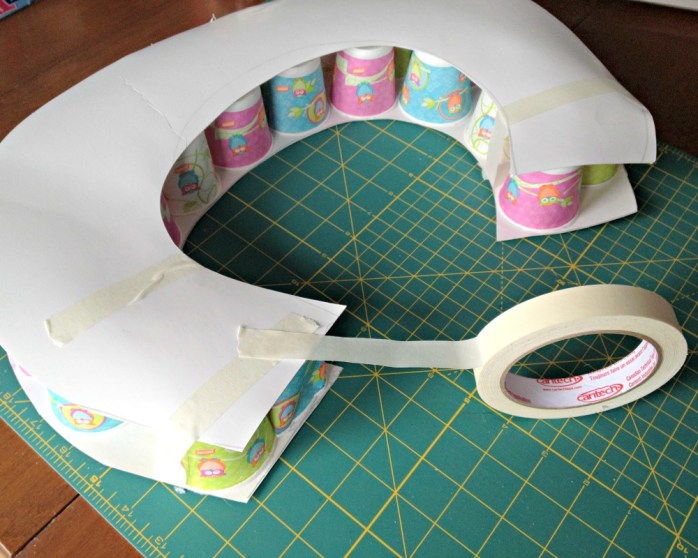
I was skeptical of my little C, once it was wrapped in masking tape. It was bumpy and ugly-looking, but I figured paper mâché would hide that (spoiler alert: nope).

I cut strips of newspaper, filled a measuring cup with water, and started stirring the water and flour together until I had a nice gloppy paste.

If you haven’t done paper mâché since you were a kid, it’s really easy and fun. You just dip your paper strips into the goop, use your fingers to remove the excess, and wrap it around your piece — in this case, the tape-covered C.

After two frustrating layers of paper mâché, my C still looked terrible. It was really bumpy and uneven, and I didn’t even think it could pass as “rustic.”
I painted it with a few coats of white, but that only make it look worse.

I thought maybe it the C wasn’t white, the imperfections might not be so obvious. So I used a tester pot of turquoise, but it still looked awful. It was time to come up with a way to salvage it!
I grabbed a $4 skein of grey yard, and sat down one night in front of the TV to begin wrapping my C. I used dots of hot glue here and there to keep everything in place, but it basically consisted of wrap, wrap, wrap, repeat. I was really careful to keep the yarn even at first — without any overlapping — and then I realized it was going to need several layers anyway. So I started wrapping it any way that looked good!

When my C was fully wrapped, I felt vindicated! It wasn’t the shiny white C I had originally wanted for my dining room, but it was a soft grey C that added texture and warmth to the basement playroom. A project that had started off so lumpy and bumpy was now something I felt happy to hang on the wall.

But I certainly won’t be mixing up a batch of paper mâché any time soon!

Paint a $3 welcome mat
Guys! I never got around to sharing last week’s DIY, so here it is — and it brought a really nice dessert because it felt bad for the lateness.
So, without further ado (or dessert talk, because DID I MENTION I’M DOING ANOTHER FITNESS CHALLENGE?) here’s my column from last weekend …
***
You don’t realize how many floral-edged, kitty-cat, cottage-y, autumn-leafy welcome mats are out there until you’re looking for a plain one.
We had been using a rubbery black mat outside our front door, but I wanted to make something that felt a little more “us.” I managed to find solid beige mats at the Dollarama for $3 each, and picked up two to see how I could customize them.

Outdoorsy activities for fashion-challenged children
Today in lame parenting news: I signed D up for Beaver Scouts!
(And yes, I’m mostly learning to not snicker when I say “beaver” because I am a responsible grown-up type.)

I don’t know what’s worse — the bucket bat, the neckerchief, or the sad little brown vest.
Where’s my Bedazzler?









As featured on …