
How we (finally) moved our shed

YouTube tutorials can be a wonderful resource when you’re trying something new. They can also fill you with false confidence and convince you to try a stupid (and potentially dangerous) idea that will leave everyone in a panic.
It all started with the placement of the shed (technically a baby barn) in our backyard. It was strangely positioned about six feet away from our deck, with a winding garden behind it. It made an already-narrow yard feel even narrower, and we talked for years about moving it … somehow … to the back of the property instead.

Well, YouTube to the rescue! We stumbled upon a video (I think it was this one) that showed a guy moving a huge shed “by hand” by rolling it on long wooden polls. It sounds crazy and, it turned out, it was crazy, but it seemed doable. Didn’t the pioneers always load barns onto logs and move them to a new homestead of something? It seemed legit.
At $30 for six posts, we decided to give it a try and see if it worked. Without going into too much detail — because no one should try this at home — we started by jacking up the shed. I was freaking out the whole time, positive the whole structure was going to come crashing down on my husband’s foot (or head).

We slipped the posts underneath and rigged up wooden skids and a pathway of pavers. The idea was that the shed would smoothly roll along them to its resting point at the back of the yard. (Fat chance.)
We pulled … and pushed … and cursed. The shed barely budged. YouTube had lied to us!
I was frustrated, but my poor Handy Husband was in such a state I was worried he’d have a heart attack. We’d torn out our garden, we’d uprooted the once-stable shed and we’d wrecked a good chunk of the yard. He actually sank down to the kitchen floor, distraught. I needed to do something!
He said we’d probably need an excavator, so I made a couple of quick calls and found a local guy who came highly recommended. He was over within the hour, and for a hundred bucks he lugged the shed exactly where it needed to be. It remains the best $100 we’ve ever spent, on anything. We were both so relieved.

Of course, the project wasn’t totally finished. We still had a large area of our yard to re-sod (another $100), re-level and secure the shed on the uneven ground, and we also built a small deck at the front.

We plan to run power out there at some point. (Right now we just have long heavy-duty extension cords.) Handy Husband sometimes talks about replacing the wooden doors with an aluminum sliding garage-style door, but I argue that it wouldn’t leave room for pretty exterior lights, so we’ll see what happens.

For now, we’re just happy the shed is in a much better spot — tucked right at the back of the yard — leaving the rest of the grass free for the kids and their friends to run around. It looks better back there and it also makes the yard look larger.
And if, for whatever reason, we lose our minds and decide to move that darn shed again? We skip the wooden posts and immediately dial the friendly guy with the excavator.
We’ve learned our lesson.

DIY photo board from a door grille

It was leaning in the corner of my client’s basement, and I recognized it immediately as one of those wooden grilles you’d see in a French door.
“Oooh! Can we use that?” — one of my favourite questions when I’m decorating a room for someone.
I didn’t know exactly what I’d do with it, but I knew I had to take it. It was the same oak as the doors and trim in her daughter’s bedroom, and I knew I could make something cool with it.
A photo board! Yes!
I could put fabric and batting behind it, and photos could be slipped behind the wooden grid. I was still fuzzy on how it was going to work, exactly, but I had the general idea.

Continue reading in my weekly DIY column, My Handmade Home …
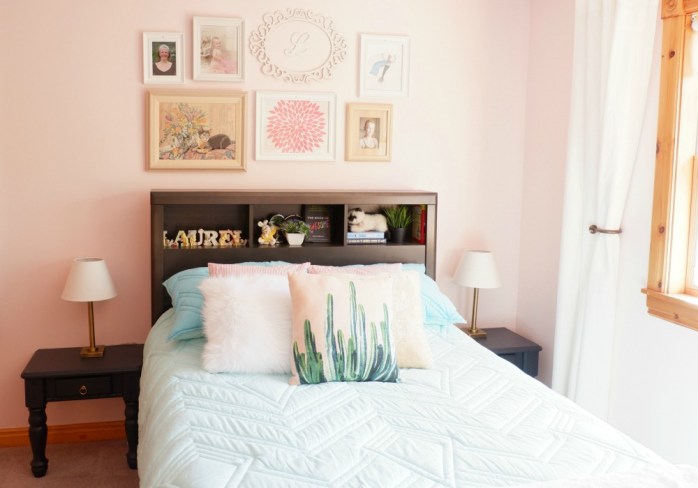
Want to see how this whole bedroom turned out? Check out these previous tutorials …


Like this post? Don’t forget to PIN IT so it’s easy to find later …

The thing about theme days

I love a good theme day.
There was nobody as excited as me when I finally got to participate in my first Crazy Hair Day at our elementary school two years ago.
I was delighted in hot-gluing LEGO bricks to barrettes and turning our son’s hair into a LEGO tornado. Our daughter still talks about how much she loved the “cupcake hair” I’d made by tugging her ballet bun through a hole in a paper plate.
For my own hairdo, I wound a high ponytail inside an empty 2L Diet Coke bottle so it “poured” out the spout. I was really proud of myself until I saw a student who’d done the same thing, except hers even poured into a Styrofoam cup. She clearly won.

The occasional theme day is fun for everyone. But do you know what is not fun for everyone? A new theme each week — especially when it’s for an after-school activity you’re paying to attend.
Ughhhhhhh.
Continue reading in my weekly parenting column, The Mom Scene …
Sneaky DIY secret of dry-brushing

It’s not that I’m lazy. I’m actually one of those people who is always doing something. I can’t even watch TV without also loom-knitting or quilting or embroidering or something.
But … I admit to being a little lazy (and sloppy) when it comes to painting. I love anything that speeds up the process of painting furniture or accessories or walls — ugh, have yet to find a way to speed up wall painting, unfortunately.
So, today I’m going to share the DIY secret that is … dry-brushing.

I’ve talked about this a few times before, in passing, but it really deserves more. Dry-brushing is exactly what it sounds like: painting something with a dry-ish brush that has hardly any paint on it.
Wait, that makes it sound like it would make the painting process longer, doesn’t it? Less paint on the brush equals more time and effort to cover the thing with paint? That’s why dry-brushing is sneaky.

Well, hang onto your paint-splattered project pants (Do they have holes? Mine have holes), because here are the three situations when I tend to break out the dry-brushing …

Continue reading in my weekly DIY column, My Handmade Home …
DIY Harry Potter costumes

And so, after spending a year feeling guilty about dropping waaaaay too much money in the stupid Halloween store — and coming to the conclusion that DIY costumes aren’t always cheaper — I present to you … our sorta-bought, sorta-DIY Harry Potter costumes …

Pretty cute, right? Here’s the breakdown of what we cobbled together for each costume …

DIY Hermione Granger costume
- Oversized drapey black cardigan of mine (for the robe)
- Plain grey dress with a black tunic layered for warmth (it’s Canada, yo)
- Gryffindor tie I sewed using this great free tie pattern
- $10 Time Turner* ordered from Chapters Indigo
- $18 Hermione Granger wand* ordered from Amazon
- Naturally curly awesome hair









As featured on …